
Greek And Roman Deities On Coins-21
2026-02-05 Thu
In #ancient #Greek religion, Hekate is honored as the goddess of #witchcraft, magic, spells, the #Moon, #night, and crossroads. She is the only child of the #Titans Perses, the god of #DESTRUCTION, and Asteria, the goddess of shooting stars. Hekate inherited remarkable powers over the heavens, #Earth, and sea from her #Parents. She represents both #kindness and cruelty. Often, she is depicted with three faces, symbolizing her #role as the goddess of boundaries and protector of crossroads.Greek art commonly shows Hekate holding torches, a #KEY, or snakes. She is frequently accompanied by dogs. A notable part of her #story includes helping Demeter search for #Persephone. Hekate guided Demeter through the night with her flaming torches. After #motheranddaughter are reunited, Hekate became Persephone’s minister and companion. To learn more about Demeter and Persephone, click on this link: Greek And Roman Deities On Coins-19
Worshippers honored Hekate in ancient Greek practices through special rituals, which included leaving food at crossroads and other boundaries. The ancient city-state of Lagina, in modern-day #Turkey, is home to the only main #Temple dedicated to Hekate. This temple served as the center of a large state #Cult. Together with #Zeus, Hekate was seen as a patron of the city, overseeing treaties and political alliances.
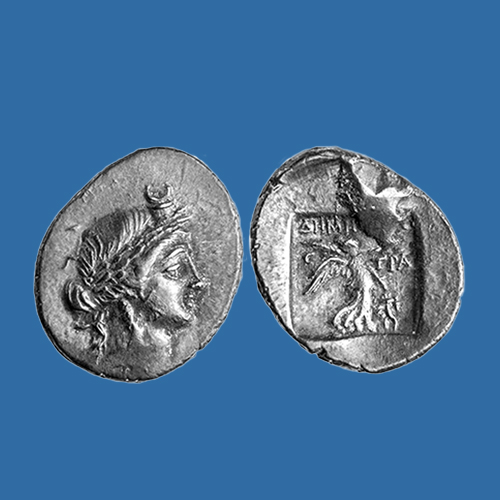
Her image began to appear on coins in the 4th century BCE. The #COIN mentioned in this post is a #Silver Drachma from Stratoniceia, dated between 188 BCE and 125 BCE. It has a dia of 18.9 mm and weighs 2.95 grams. On the obverse, it shows Hekate’s head facing right, adorned with a crescent. The reverse displays #Nike moving to the right, with a cornucopia below. Additionally, there are incomplete Greek letters visible like '????' and 'TPA,' all within an incuse square. To learn more about Nike refer to following link: Greek And Roman Deities On Coins-9.
On Narak Chaturdashi (Kali Chaudas), it is a #traditional ritual, particularly in Gujarati #culture, to place food items like vada at a four-road intersection, known as "kakraat kadhvu". This practice symbolizes the removal of negativity, #evil spirits, and misfortune from the #home by allowing vehicles to crush the offerings.
Key details regarding this tradition include:
Ritual Purpose: The act is believed to ward off evil, negative energies, disputes, and quarrels, ensuring prosperity and #Peace for the household.
Offerings: Specific items, often referred to as Kakraat na Vada or Chhum Vada, are made and left at crossroads. These can include dal vada, dahi vada, or bhajiyas.
Timing: This is usually performed on the night of Kali Chaudas, which falls on the 14th day of the Krishna Paksha in the Kartik month, just before Diwali.
Cultural Context: In addition to the food, some traditions also involve placing #oil #lamps (diya) at crossroads, as per the Narad Puran to bring fearlessness to the worshipper.
Latest News
-
Extremely Rare Silver Quarter Tanka of Kachar Monarch Yasho Narayan, Owing Allegiance to Ghatotkacha Lineage
2026-06-23 TueHidden within the misty valleys and forested hills of Northeast India lies the story of the Kacha...
-
Gun and Sword on Silver Katra Taka of Independent Kingdom of Jaintiapur King Bar Gossain II
2026-06-22 MonThe Jaintia was a prominent medieval Independent Kingdom in Northeast India, ruled ...
-
Rare and Beautiful Gold Dinar of Gauda Ruler Shashanka
2026-06-19 FriThe Gauda dynasty was an ancient kingdom in the Gauda region of Bengal. It emerged as an independ...
-
Exceptional Gold Mohur of Ahom King Swargdeo Rajeshwar Singha
2026-06-19 FriThe Ahoms were ethnic group originating from the Tai people and founder of Assamese royal dynasty...
-
Heavy Lead Coin of Hiranyakas, King Khadakama
2026-06-18 ThuThe Hiranyakas were a local dynasty that rose in the mid-3rd century CE, in Rayalaseema region th...